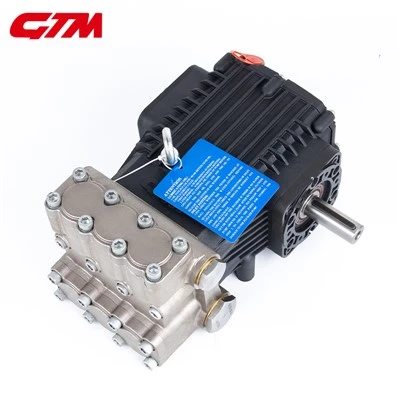

Pressure: The strength of the force required to break down and remove dirt, representing the impact intensity and capability. The harder the dirt, the higher the pressure required. For oilfield production pipes and water well pipes, a pressure of 700-1400 bar is generally required. Through our experiments, a maximum pressure of 1400 bar and an operating pressure of 1350 bar meet the destructive force requirements for cleaning almost all scaled pipes.
Flow Rate: A factor affecting flushing capacity and impact frequency. The higher the flow rate, the higher the cleaning efficiency. Through our experiments and practice, under a pressure of 1350 bar, a flow rate of 44 L/min can ensure simultaneous operation of 8 nozzles, maximizing the rotating cleaning surface.
Time: The longer the time, the higher the cleaning frequency, and the better the cleaning efficiency. A 2-minute interval is required per pipe, equivalent to 4 seconds for both the upper and lower sections, 60 seconds for forward movement, 20-40 seconds for backward movement, and 16 seconds for other sections. For a 10-meter long pipe, this equates to approximately 0.18 meters per second forward. The 8-nozzle ultra-high pressure jet rotation cleaning requires an adjustable rotation speed of 420 rpm or higher.
Temperature: Temperature can melt and loosen the structure of grease and grime, making it more fluid and easier to remove. Generally, a 1350 bar water jet generates about 30-40°C of frictional heat, allowing for simultaneous cold washing, descaling, and wax removal without problems. However, cold washing for descaling and wax removal is very difficult in ambient temperatures of 0-15°C, and even more impossible in environments of -50 to 0°C. When working below 15°C, the water temperature needs to be maintained at 15-20°C, but the wax removal temperature requires a level above 30°C.